

 English
 中文简体
 русский
 Español
 عربى
A multimeter cannot tell an alkaline AA from a lithium AA. Fresh cells from both chemistries read 1.5 V, both fit the same 14.5 mm by 50.5 mm compartment, and both are sold in four-packs. The difference appears forty minutes into a 500 mA load, when a premium alkaline cell has sagged to about 1.10 V and a lithium iron disulfide cell is still holding 1.45 V. In continuous-drain testing that gap becomes roughly 2.5 times the usable capacity, and it is why a wireless door lock can run a year on lithium while alkaline gives up in a season. For anyone weighing alkaline vs lithium AA batteries for a product design, a private-label program or a maintenance contract, the decision rests on four measurable numbers rather than on a voltage rating.
Alkaline vs Lithium AA Batteries: The Four Numbers That Decide It
Four measurements settle the choice for most buyers: usable capacity at the device drain rate, capacity retention at the coldest temperature the product will see, shelf life in the warehouse, and cost per hour of operation. Everything else in the alkaline versus lithium argument follows from those four.
Both chemistries are tested under the same IEC 60086-2 primary battery standard, so the figures below are measured values rather than marketing estimates.
| Parameter | Alkaline AA (LR6) | Lithium AA (Li-FeS2, FR6) |
| Nominal voltage | 1.5 V | 1.5 V |
| Voltage at 50 percent discharge | 1.15 to 1.25 V | 1.45 to 1.50 V |
| Usable capacity at 25 mA | 2,600 to 2,850 mAh | 2,900 to 3,000 mAh |
| Usable capacity at 500 mA | 900 to 1,100 mAh | 2,500 to 2,900 mAh |
| Usable capacity at minus 20 C | 200 to 400 mAh | 2,200 to 2,500 mAh |
| Shelf life at 20 C | 5 to 10 years | 15 to 20 years |
| Cell weight | 22 to 24 g | 14 to 16 g |
| Bulk price per cell | 0.12 to 0.30 USD | 0.70 to 1.20 USD |
| Typical fit | Remotes, clocks, low-drain sensors | Cameras, locks, GPS trackers, cold rooms |
Working rule: below 50 mA, alkaline AA is normally the cheaper answer. Above 300 mA, below freezing, or past five years of storage, lithium AA earns its higher price.
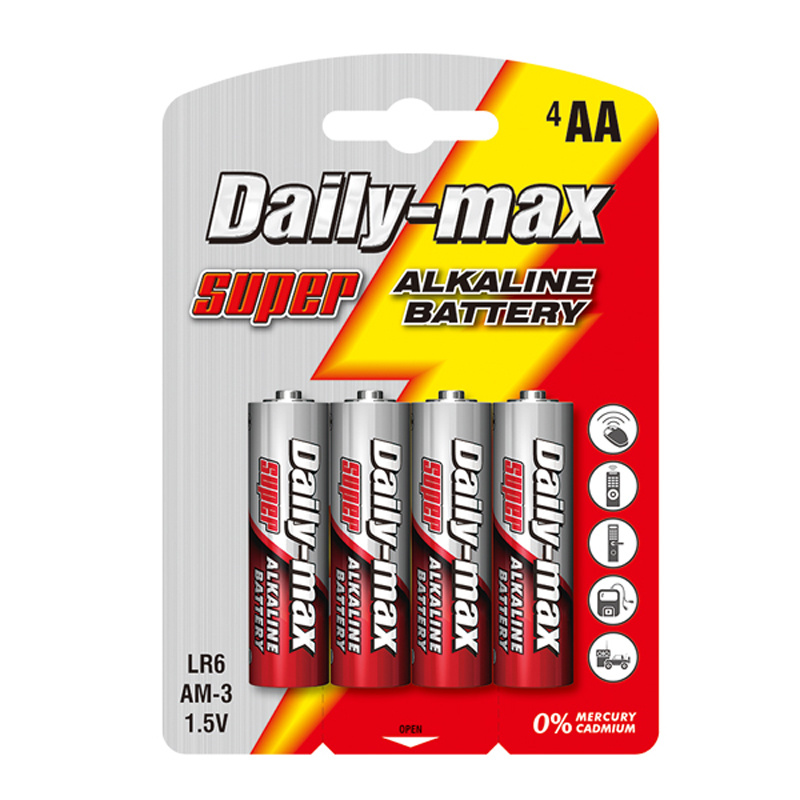 LR6-4B Business Alkaline AA BatteryA 1.5 V AA alkaline cell rated 2200 mAh at 43 Ω, intended for business and professional use in high-drain devices.View Product →
Why Two 1.5 V Cells Deliver Such Different Runtime
A 1.5 V rating describes an open-circuit voltage, not the voltage a device actually sees while it works. That single distinction explains almost every practical difference between the two chemistries.
Alkaline AA cells pair zinc powder with manganese dioxide and a potassium hydroxide electrolyte. Internal resistance starts around 0.15 to 0.30 ohm when fresh and climbs past 1 ohm as the cell discharges, so terminal voltage slides from about 1.55 V down to the device cut-off. In a wall clock that slide takes a year. In a motorised toy it takes twenty minutes.
Lithium iron disulfide AA cells hold internal resistance near 0.10 to 0.20 ohm for most of their life. Terminal voltage stays above 1.4 V until roughly 90 percent of the capacity is spent, then collapses over the final few percent.
A 1.5 V label is not a promise. The alkaline cell spends most of its working life below 1.3 V, while the lithium cell holds above 1.4 V until it is nearly empty.
That curve shape explains two behaviours engineers see in the field. Devices with a high cut-off, such as 1.2 V sensor modules or boost-converter circuits, pull far more energy out of lithium. Devices with a 0.9 V cut-off, such as a flashlight bulb or a simple oscillator, drain alkaline completely and give up only the last few percent of lithium capacity.
Runtime: How Much Longer a Lithium AA Actually Lasts
Lithium AA delivers about 2 to 3 times the usable capacity of alkaline AA in high-drain devices, and only about 5 to 15 percent more in low-drain devices. The load, not the label, sets the size of the advantage.
Translate the bars into your own duty cycle. A wireless door lock that draws 500 mA for six seconds per unlock and microamps in standby uses almost no energy per event, so both chemistries last a year. A trail camera firing three hundred shots a night at 400 mA is the opposite case, and there the difference between two hours and five hours of equivalent continuous runtime decides whether the cells are changed every few weeks or every few months.
Field rule: count battery changes, not milliamp-hours. At 500 mA a premium alkaline AA gives roughly 2 hours of continuous run time from a fresh cell, while a lithium AA gives roughly 5.4 hours from the same compartment.
Cost per Hour: When the Cheap Cell Stops Being Cheap
Alkaline AA remains cheaper per hour in most devices, including high-drain ones. Lithium AA wins on total cost only once labour, downtime or cold weather enters the calculation.
With typical wholesale prices of 0.12 to 0.30 USD for a quality alkaline AA and 0.70 to 1.20 USD for a lithium AA, the arithmetic is blunt. At 25 mA a 2,800 mAh alkaline cell runs about 112 hours at roughly 0.002 USD per hour, while the lithium cell costs about 0.008 USD per hour for nearly the same run time. At 500 mA, alkaline falls to about 2 hours and 0.10 USD per hour, while lithium delivers about 5.4 hours at 0.17 USD per hour.
So lithium does not win on energy cost. It wins on the cost of everything around the energy, which is why the comparison flips the moment a technician is paid to change the cells.
Alkaline AA wins when
- Device current stays below 50 mA
- The product lives indoors, between 10 C and 30 C
- End users replace cells themselves at no labour cost
- Three years of shelf life is enough
- Retail price point matters more than run time
Lithium AA wins when
- Continuous or pulse current exceeds 300 mA
- The device sits outdoors, in a vehicle or in a freezer
- A service visit costs more than the cells, for example 30 USD against 0.70 USD
- The product ships with cells installed and may sit for years
- Weight matters, since lithium AA is roughly 35 percent lighter
Cold Weather, Heat and Shelf Life: Where Alkaline Loses Ground
Alkaline AA loses most of its usable capacity at minus 20 C while lithium AA keeps roughly 85 percent, and lithium also holds a charge for 15 to 20 years against 5 to 10 years for alkaline.
Cold slows the alkaline reaction and raises internal resistance, so a cell that gives 1,050 mAh at room temperature may give 200 to 400 mAh in a freezer or an outdoor cabinet. Li-FeS2 chemistry keeps working because its electrolyte stays conductive well below minus 20 C.
Heat is the other direction. Self-discharge roughly doubles for every 10 C above 20 C, so a year of storage at 40 C can cost an alkaline cell 10 to 15 percent of its capacity and a lithium cell about 3 percent. Warehouses holding both chemistries should rotate stock first-in, first-out and print the date code where the buyer can read it.
If the product sits in an unheated cabinet, a vehicle or a freezer, alkaline is the wrong chemistry no matter how good the unit price looks.
Leakage, Shipping and the Lithium Naming Trap
Three unrelated chemistries are sold as lithium cells, and only one of them is a 1.5 V drop-in replacement for alkaline. Confusing them is the most expensive mistake in this category.
Lithium iron disulfide, coded FR6, is the 1.5 V primary AA covered in this comparison. Lithium ion in the 14500 format has the same shell size but delivers 3.7 V, is rechargeable, and will damage a device built for 1.5 V. Lithium manganese dioxide is a 3 V coin cell, the type found in key fobs, thermometers and medical patches.
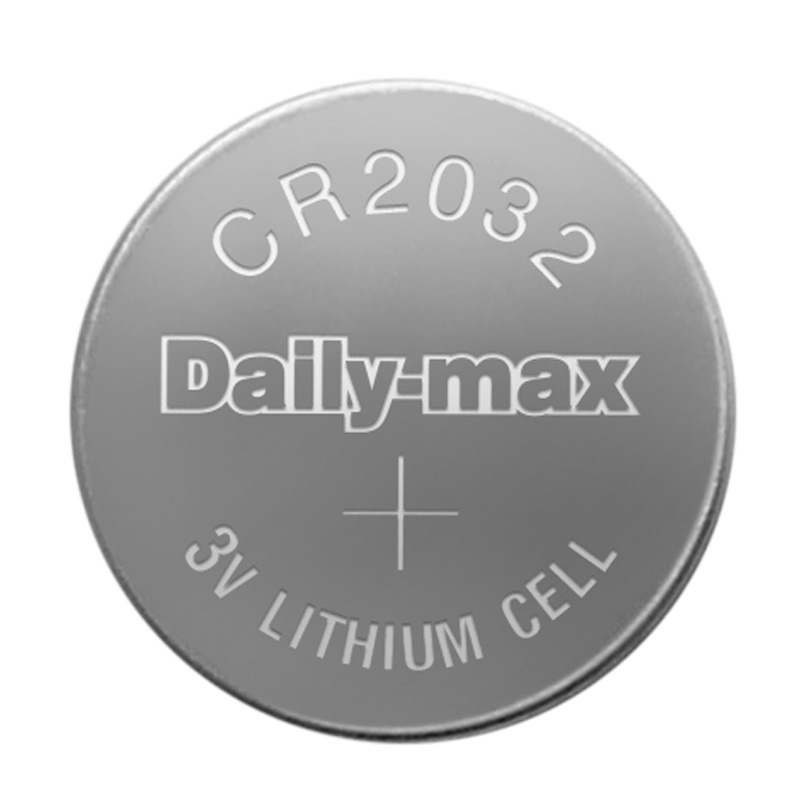 CR2032 3V Lithium Manganese Button CellCompact non-rechargeable 3 V Li-MnO2 coin cell with 210 mAh, suited to watches, calculators, key fobs, and medical equipment.View Product →
Leakage is the second practical difference. Alkaline cells vent potassium hydroxide when they are over-discharged, stored hot, or left in a device for years, and the residue corrodes plated contacts. Lithium AA cells generate far less internal gas pressure at end of life, so the leak damage that drives consumer complaints is much rarer.
Shipping rules separate the two as well. Alkaline AA is not classified as dangerous goods. Lithium metal cells move under UN3090, and because a Li-FeS2 AA contains well under 1 gram of lithium it falls into Section II, which permits air carriage with the lithium battery mark and per-package quantity limits. Importers moving cells by air should confirm that paperwork before the first pallet ships.
Sourcing Alkaline or Lithium AA in Volume: What Belongs in the Specification
A workable purchase specification states the discharge test the supplier reports, the date code printed on every cell, the packaging format for the sales channel, and the certification file the retailer will ask for.
- Fix the test conditions first. Ask for capacity at 25 mA continuous, at 500 mA continuous, and on a pulse profile that matches your device. A single milliamp-hour figure without a stated load is not a specification.
- Require lot codes and a printed shelf-life date on the cell and the pack, plus the storage conditions the supplier used.
- Match packaging to the channel: carded 2B and 4B packs for retail shelves, shrink-wrapped and black-gold industrial packs for OEM lines and maintenance contracts.
- Confirm the scope of certification, not just the logo: ISO 9001 and ISO 14001 for the factory, UL, CE, RoHS and REACH for the product file.
- Ask for the lot-to-lot capacity spread. Consistency between shipments matters more than one strong test result.
Changzhou Strengh (Anyida) Power Technology Co., Ltd., a primary battery manufacturer based in Changzhou, Jiangsu, produces alkaline, carbon zinc and button lithium manganese cells in both business and industrial outfits, and lists ISO 9001, ISO 14001, UL, CE, RoHS and REACH certification on its site. Buyers comparing alkaline and lithium AA supply should request discharge curves and packaging samples rather than a price list alone.
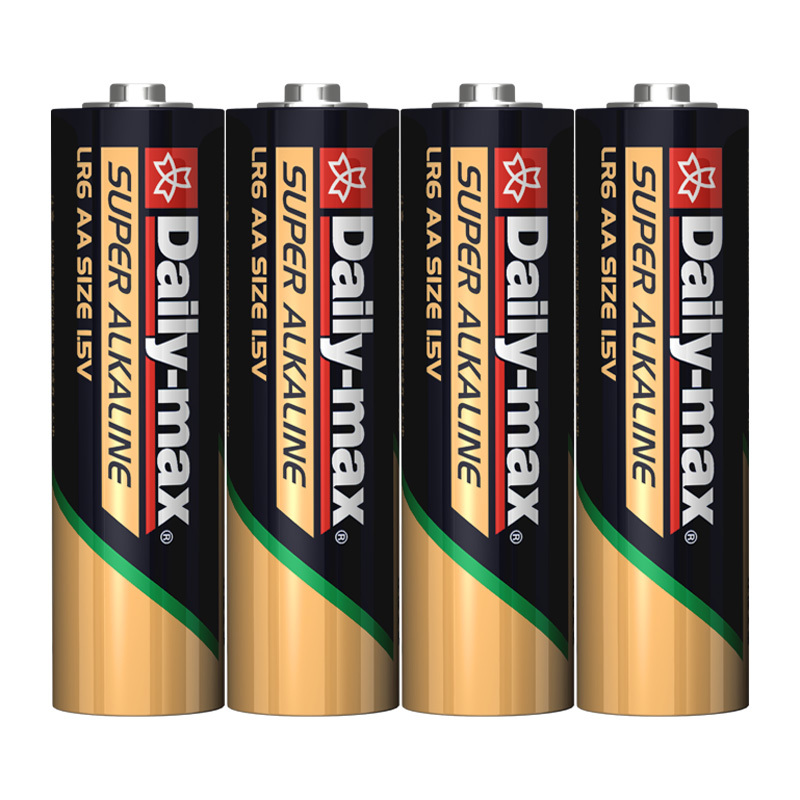 LR6 Black Gold-4S Alkaline AA Battery1.5 V AA alkaline battery with 2200 mAh at 43 Ω and leak-resistant construction for flashlights, toys, and digital gadgets.View Product →
FAQ: Alkaline vs Lithium AA Batteries in Practice
Can I use a lithium AA in any device that takes an alkaline AA?
Physically yes, because both share the 14.5 mm by 50.5 mm format and both are rated 1.5 V. Electrically, a fresh Li-FeS2 cell sits at 1.7 to 1.8 V open circuit, which is above the 1.65 V ceiling some low-cost devices and older sensor modules are designed for. Check the maximum input voltage of the device before switching an entire fleet.
Which battery lasts longer, alkaline or lithium AA?
Lithium AA lasts longer in every device, but the margin depends on the load. At 25 mA the two chemistries are within 5 to 15 percent of each other. At 500 mA lithium delivers about 2.5 times the usable capacity, and in freezing conditions the gap widens to three times or more.
Are lithium AA batteries rechargeable?
No. Li-FeS2 AA cells are primary cells and must never be charged. A rechargeable lithium cell in the same footprint is a 3.7 V lithium ion 14500, which needs a dedicated charger and is not a 1.5 V replacement. Mixing the two is a common cause of damaged devices.
How are lithium AA cells shipped?
Lithium metal cells ship as UN3090 dangerous goods. Because a Li-FeS2 AA holds well under 1 gram of lithium, it falls under Section II, which allows air carriage with the lithium battery mark and per-package quantity limits. Alkaline AA cells are not classified as dangerous goods.