

 English
 中文简体
 русский
 Español
 عربى
An AAA carbon battery is a 1.5 V zinc-manganese dioxide primary cell in the IEC R03 outline, 10.5 mm in maximum diameter and 44.5 mm in maximum height, chosen for low-drain devices where cost per cell outweighs milliamp-hours.
Send out a request for quotation on a retail program and the price rarely comes back first. The supplier asks whether the cell should be zinc-carbon or zinc-chloride, whether it ships on a two-piece card or in a shrink pack, and which cut-off voltage the host device can tolerate. Each answer moves the unit price, the shelf-life figure printed on the pack, and the line the cells run on.
What follows is the R03 family as it is actually bought and sold: the chemistry split behind the R03S and R03P codes, the discharge and temperature limits that decide device fit, the storage rules that protect a carton for two years, and the packaging and compliance checks that keep a shipment out of customs trouble.
What an AAA carbon battery is, and what the R03 code tells you
An AAA carbon battery is a zinc-manganese dioxide primary cell in the IEC R03 size, rated at 1.5 V nominal and built to the dimensional limits of IEC 60086-2, which caps it at 10.5 mm in diameter and 44.5 mm in height.
IEC 60086-2 encodes the chemistry inside the size code: R03S is the ammonium chloride salt cell sold as carbon zinc, R03P is the zinc-chloride heavy-duty variant, and LR03 is the alkaline cell that shares the same 10.5 by 44.5 mm envelope.
Inside the cell, a zinc can acts as both the negative terminal and the container. Manganese dioxide blended with carbon powder forms the cathode, a separator keeps the two apart, and the electrolyte completes the circuit, ammonium chloride in an R03S and zinc chloride in an R03P. Because the zinc can is consumed as the cell discharges, the chemistry tolerates over-discharge poorly: once the can is eaten through below roughly 0.9 V, gas builds and electrolyte can escape past the seal.
The zinc-chloride R03P uses a higher-purity zinc can and a zinc chloride electrolyte. That lifts capacity by a step that published data places at roughly 30 to 40 percent and cuts gas generation during storage, which is why R03P rather than R03S is the default for export programs.
| Property | R03S carbon zinc | R03P zinc chloride | LR03 alkaline |
| Electrolyte | Ammonium chloride | Zinc chloride | Potassium hydroxide |
| Nominal voltage | 1.5 V | 1.5 V | 1.5 V |
| Typical AAA capacity | 300 to 400 mAh | 450 to 550 mAh | 1,000 to 1,200 mAh |
| Published shelf life | 2 to 3 years | 2 to 3 years | 5 to 7 years |
| Relative unit cost | Lowest | Low to mid | Highest |
| Duty cycle it suits | Clocks, remotes, standby loads | Timers, toys, moderate drain | Motors, backlights, cold rooms |
Where an AAA carbon cell still beats an alkaline cell
AAA carbon cells stay the cheaper choice in devices that average under about 10 mA and sit idle for weeks; alkaline AAA wins once average drain passes roughly 50 mA, because the extra capacity finally converts into runtime instead of sitting unused.
The crossover is a function of how the device spends its hours, not what it costs. A wall clock draws microamps and will run a year or more on a zinc-chloride cell, so the 1,000 mAh an alkaline cell offers is capacity thrown away at the next replacement. A motorised toy or a camera flash pulls several hundred milliamps in bursts, and at that rate the internal resistance of a carbon cell drags voltage down before capacity is used, so the alkaline cell delivers usable voltage for longer and earns back its price.
Two categories should never take the carbon chemistry: smoke alarms and medical devices. Both depend on a predictable low-voltage warning, and the steeper voltage curve of a carbon cell pushes that warning later than the safety design assumes. IEC 60086-5 states the safety requirements for aqueous-electrolyte cells, but meeting a safety standard does not make a cell suitable for a life-safety load.
Rule of thumb: if the device idles for months and draws a few milliamps, the lower capacity of an AAA carbon battery never shows up on the user side; if it drives a motor, a lamp or a radio, the alkaline cell is cheaper per hour of use.
Retail programs that sell single replacement cells rather than multipacks usually standardise on a small hanging card, which sits on a pegboard without a blister and keeps packaging cost below a two-piece card.
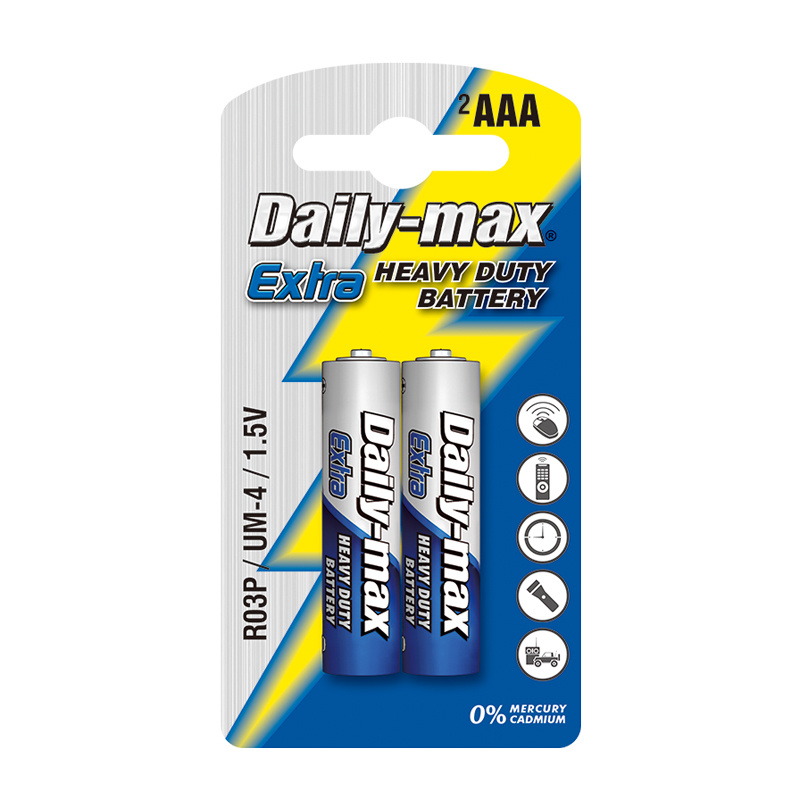 Custom ODM/OEM AAA R03P-2B Carbon Battery Hanging CardTwo-pack AAA carbon-zinc cells on a compact hanging card, suited to retail pegboard programs and custom ODM/OEM orders.View Product →
Capacity, cut-off voltage and temperature in real numbers
Published AAA capacities run from 300 to 400 mAh for an R03S, 450 to 550 mAh for a zinc-chloride R03P and 1,000 to 1,200 mAh for an alkaline LR03, all quoted to a 0.9 V cut-off at 20 °C.
IEC 60086-2 is the document that makes those figures comparable. It fixes the discharge temperature at 20 °C plus or minus 2 °C and sets an end voltage for each application test, so a capacity claim without a stated load, temperature and cut-off is a marketing number rather than a specification. Two quotations for the same R03P part number often disagree until both sheets are recalculated on the same load.
A longer walkthrough of discharge curves and application tests sits in the site's AAA carbon battery performance guide, which pairs the IEC test conditions with the load profiles that appear in real devices.
Temperature is the second variable. At 0 °C the internal resistance of a zinc-can cell climbs and usable capacity falls faster than in an alkaline cell, which is why outdoor sensors and cold-room timers are specified on alkaline or lithium chemistry. Above 45 °C the opposite problem appears: self-discharge accelerates and shelf life shortens, so a container left on a sun-exposed dock through July ages before it is opened.
Storage, shelf life and self-discharge
A sealed AAA carbon battery carries a published shelf life of two to three years at 20 °C against five to seven years for an alkaline cell, and both figures assume unopened packaging and a storage area held below 25 °C.
Four storage rules change the outcome more than any other variable:
- Hold stock below 25 °C and between 45 and 75 percent relative humidity; condensation on cold cells corrodes plated caps faster than discharge ever will.
- Keep cells in the card or shrink pack until use, because loose cells in a bin short-circuit against each other and lose charge without powering anything.
- Rotate first-in, first-out and print the production date on the outer carton, since the two-to-three-year clock starts at manufacture, not at delivery.
- Never refrigerate or freeze carbon zinc cells; the condensation that forms on the way back to room temperature does more damage than cooler storage prevents.
Shelf life is a storage specification, not a battery specification: the same R03P cell is a three-year part in a climate-controlled warehouse and a much shorter one on a hot loading dock.
Card packs, hanging cards and industrial shrink packs
The same R03P cell ships in four formats, a two-piece card, a four-piece card, a small hanging card and a shrink-wrapped industrial pack, and the format drives more of the handling cost per unit than the cell does.
| Format | Cells per unit | Channel it fits |
| Two-piece card | 2 | Pegboard retail, single-device replacement |
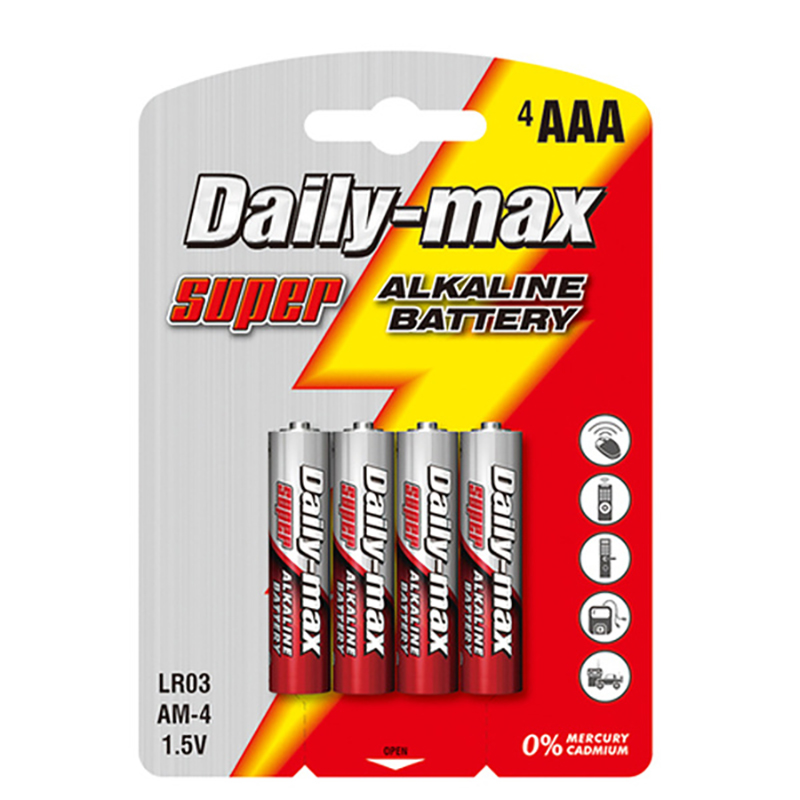
| Four-piece card | 4 | Supermarket multipacks, household stock |
| Small hanging card | 2 | Convenience retail, low unit price points |
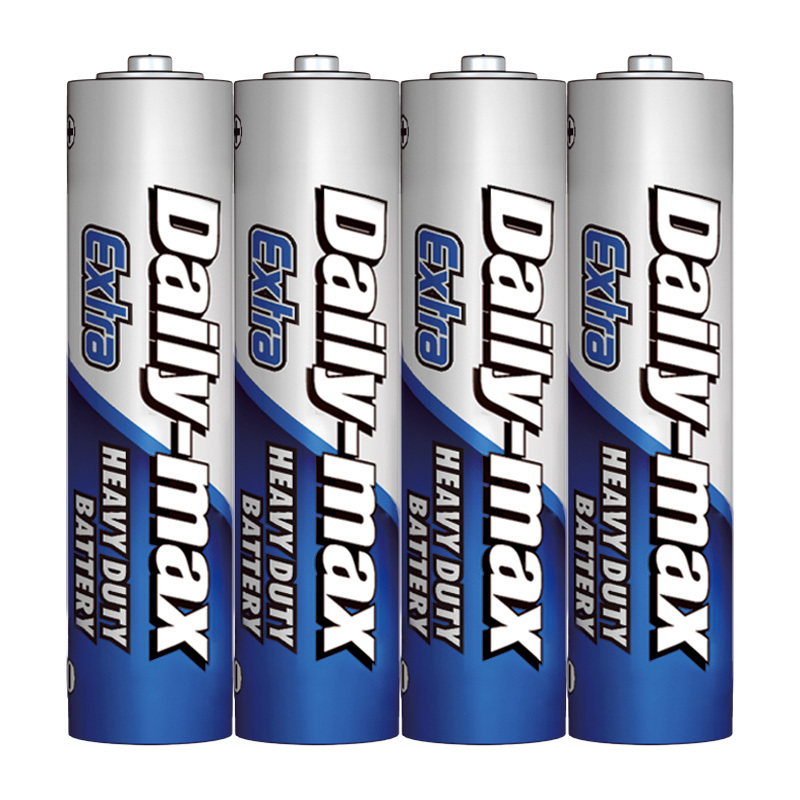
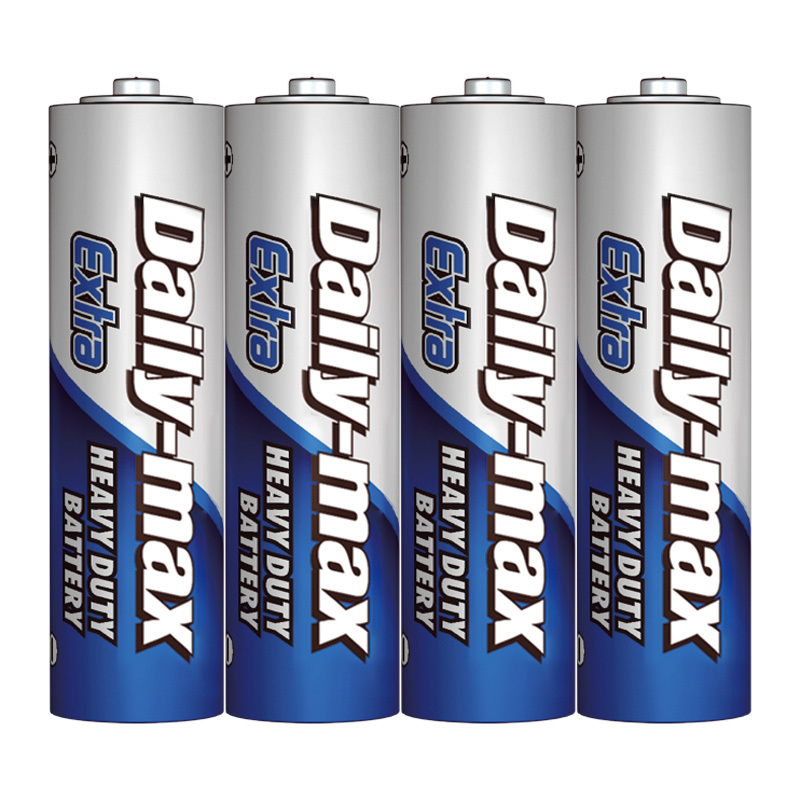
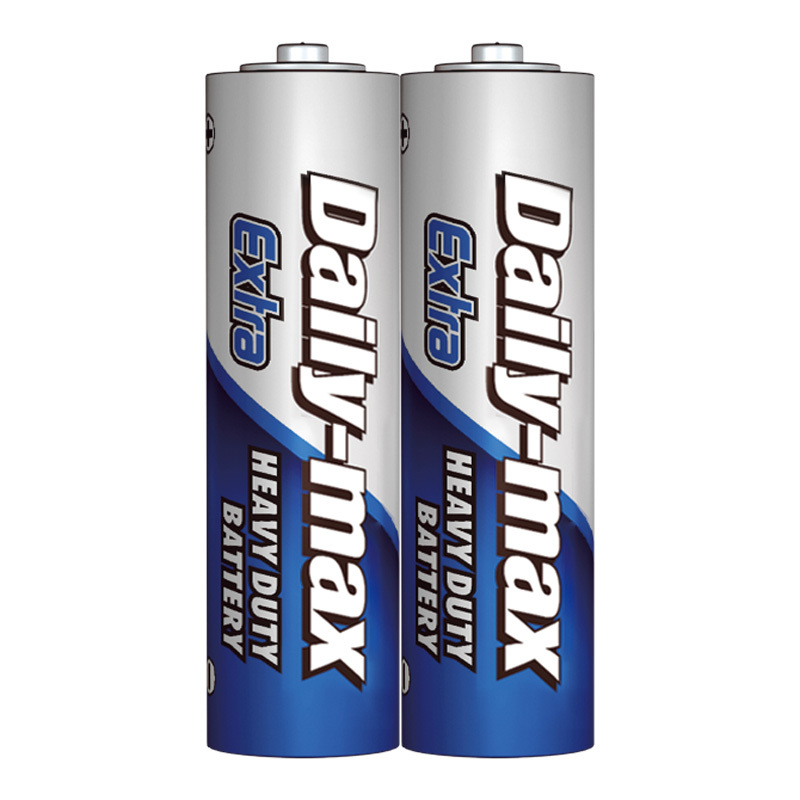
| Shrink pack, silver-blue 2S | 2 | Trade counters, OEM spare kits |
| Shrink pack, silver-blue 4S | 4 | Industrial replacement, maintenance stock |
Carded formats carry printed voltage, polarity, warning text and a barcode, and that artwork is what importers approve before a first shipment, so a card change costs more calendar time than a cell change does.
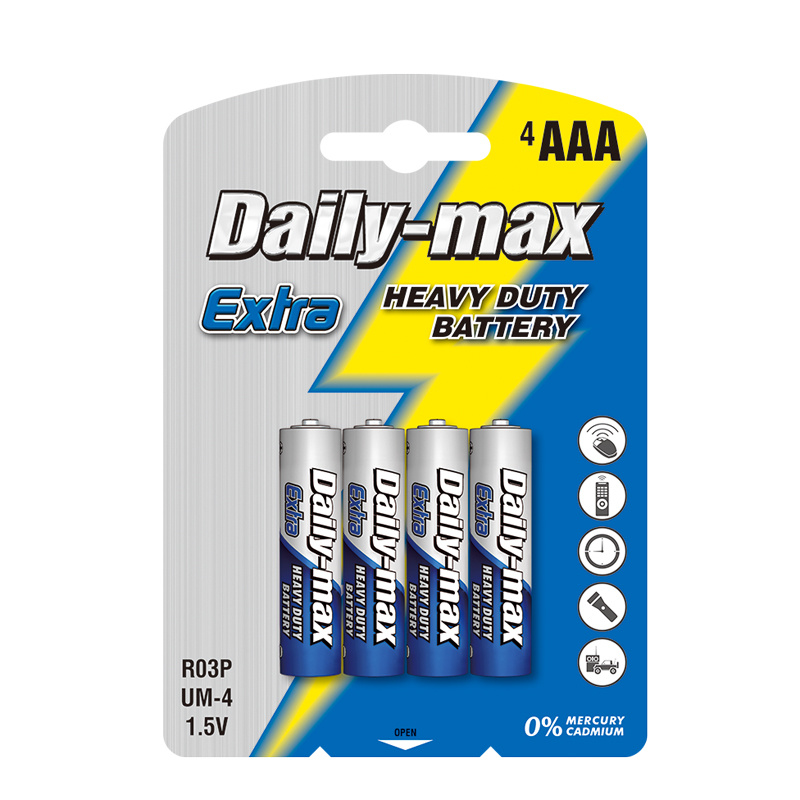 AAA R03P-4B Carbon Battery Four-Pack CardFour-pack mercury-free AAA carbon-zinc batteries in carded packaging, with artwork for import approval and custom ODM/OEM supply.View Product →
Industrial packs, OEM programs and the paperwork that clears an order
An industrial AAA carbon battery order is settled by four documents: an IEC 60086-2 discharge report, a mercury declaration against the 0.0005 percent by weight limit in EU Regulation 2023/1542, a current ISO 9001 certificate, and an approved packaging artwork.
- Mercury: EU Regulation 2023/1542 carries forward the 0.0005 percent limit set by Directive 2006/66/EC, so ask for a test report rather than a written assurance.
- Transport: zinc-carbon and alkaline cells are not lithium cells, so UN 38.3 air-freight testing does not apply and a dry-cell statement normally satisfies the forwarder.
- Marking: polarity, nominal voltage, production date and the disposal symbol must fit the artwork of whichever pack format is ordered.
- Traceability: request the batch code on the outer carton, because a shelf-life claim cannot be enforced without it.
Changzhou Strengh (Anyida) Power Technology Co., Ltd. lists ISO 9001, ISO 14001, UL, CE, RoHS, SGS and REACH among its certifications and reports a plant of more than 50,000 square metres, annual capacity listed as 120,000 plus without a stated unit of measure, and exports to more than 30 countries. Those figures are the company's own published statements rather than audited data, and the same source puts engineering staff above 25 percent of the workforce. Dimensional and discharge data for the R03 line is published as an R03 technical datasheet in PDF.
Shrink-packed configurations are the usual unit for trade counters and OEM spare kits, since they remove the printed card from the cost build.
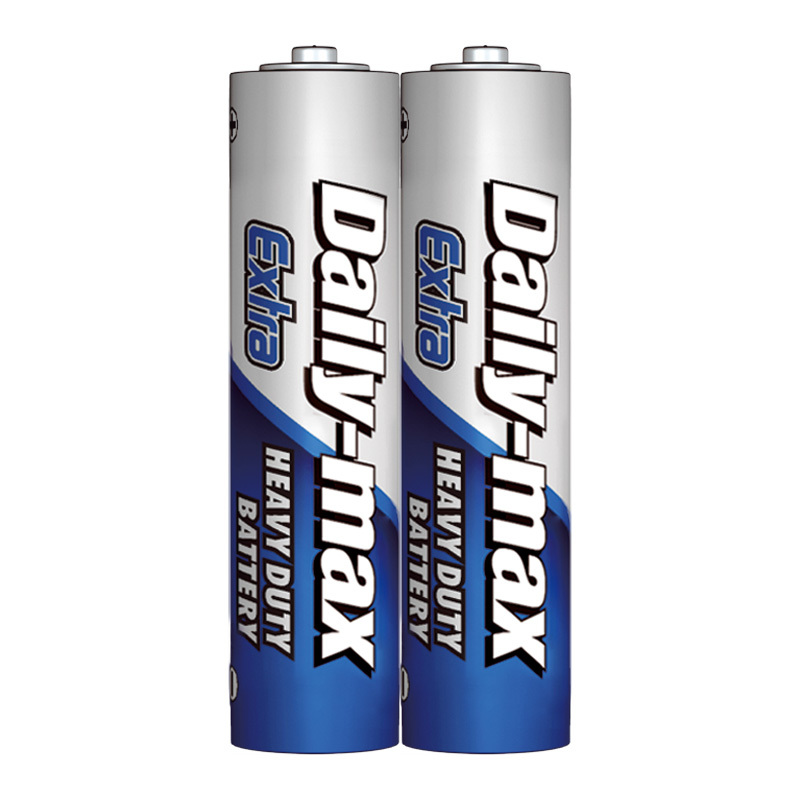 R03P Silver Blue-2S Carbon Zinc BatteryShrink-packed AAA carbon-zinc cells suited to trade counters and OEM spare kits, offering a low-cost power option for small devices.View Product →
Practical questions buyers ask before specifying
Is R03 the same as AAA?
Yes. R03 is the IEC size designation and AAA is the retail name for the identical 10.5 mm by 44.5 mm cell. The chemistry sits in the suffix: R03S for ammonium chloride carbon zinc, R03P for zinc chloride, LR03 for alkaline.
How long will an AAA carbon battery last in a television remote?
A remote that averages under 1 mA and is used for a few minutes a day typically runs 12 to 24 months on an R03P cell. Devices with backlights, voice search or Bluetooth pairing push average drain past 20 mA and belong on alkaline chemistry.
Do AAA carbon batteries leak?
They can, and over-discharge is the mechanism. When the zinc can is consumed below about 0.9 V, the cell generates gas and electrolyte can escape past the seal. Remove dead cells from stored devices, and specify R03P where leakage claims matter, because it produces less gas than R03S.
What should a first purchase order specify?
Six items: the IEC code, the pack format, the cut-off voltage the device needs, the destination market and labelling language, the annual volume, and the batch-code requirement. With those, a factory can quote a firm price and lead time instead of a range.
Match the chemistry to the duty cycle rather than the shelf label: an R03P at 450 to 550 mAh covers clocks, remotes and timers, while an LR03 only earns its price where the device pulls more than 50 mA.